
Mountable Zip Ties and Zip Tie Mounts
for Wires & Cables
Mounting Zip Ties – Screw Mount Cable Ties for Secure Cable Routing
Keep cables organized, anchored, and exactly where they belong.
Loose cables can make workspaces difficult to maintain and equipment installations harder to manage. Mounting zip ties provide a practical solution by combining cable bundling with a built-in attachment point.
Unlike standard cable ties that simply hold wires together, screw mount cable ties allow you to fasten bundles directly to suitable walls, panels, frames, and equipment surfaces.
Explore TIESELX mounting cable ties for organized, surface-mounted wiring in residential, commercial, automotive, and workshop applications.
Integrated Mounting Hole • Secure Cable Routing • Durable Nylon • Indoor & Outdoor Options
Shop Mounting Zip Ties
Find dependable cable fastening solutions for projects where cable bundles need to stay in a fixed position.
Showing all 4 results
-
Cable Clips
TIESELX Nylon Universal Cable Tie Buckle Clips – Push-Mount Zip Tie Fasteners for Car Fender, Engine Cover & Mudguard | With Storage Box
$8.99 – $13.99Price range: $8.99 through $13.99 This product has multiple variants. The options may be chosen on the product page -
Mounting Zip Ties
TIESELX Screw Mount Cable Ties 200 Pack – 8 Inch, 50 LB, UV Resistant Nylon 66, Black
$14.99 -
Mounting Zip Ties
TIESELX Screw Mount Cable Ties 200 Pack – 10 Inch, 50 LB, UV Resistant Nylon 66, Black
$14.99 -
Mounting Zip Ties
TIESELX Screw Mount Cable Ties 200 Pack – 12 Inch, 50 LB, UV Resistant Nylon 66, Black
$14.99

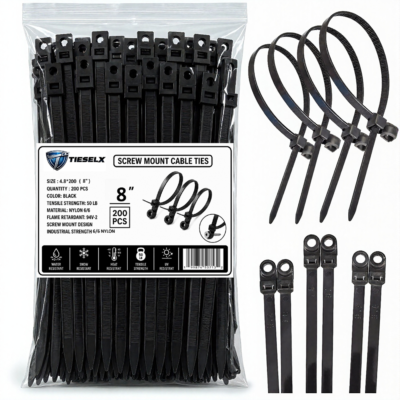
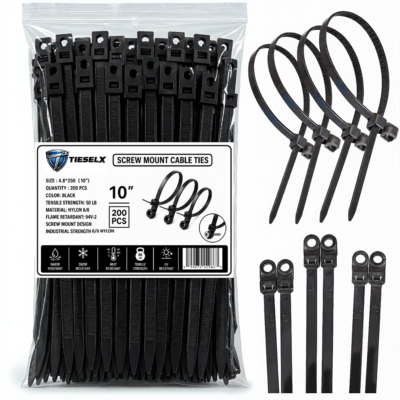
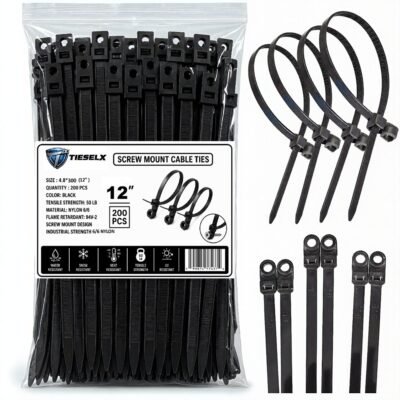
TIESELX offers screw mount cable ties in 8-inch, 10-inch, and 12-inch lengths, giving you options for different bundle sizes and routing requirements.
Our mounting cable ties are designed to help you organize wires while attaching them to a suitable surface with compatible hardware.
Whether you’re handling a small DIY project or planning multiple cable runs, compare the available lengths and select the right option for your installation.
What Are Mounting Zip Ties?
Mounting zip ties, also called screw mount cable ties or screw hole zip ties, are nylon cable fasteners with an integrated mounting eyelet.
The strap wraps around cables in the same way as a traditional zip tie. The additional mounting hole lets you anchor the bundled cables to a panel, bracket, wall, or another compatible surface using a screw.
This two-in-one design helps manage both cable bundling and cable positioning.
Mounting ties are especially useful when wires need to follow a planned route rather than hang loosely or move around inside equipment.
Why Use Cable Ties With Mounting Holes?
- Controlled cable positioning: Keep wire bundles close to their intended routing path.
- Integrated fastening: Combine bundling and surface attachment in one component.
- Reduced cable movement: Help prevent loose wiring from shifting during normal use.
- Cleaner installations: Route cables neatly along walls, equipment panels, and frames.
- Practical maintenance: Create organized cable runs that are easier to inspect and trace.
For general bundling that does not require surface attachment, explore our nylon cable ties.
Choose the Right Screw Mount Cable Tie Size
Selecting the correct length is important for both installation convenience and cable organization.
The tie must wrap around the complete cable bundle while leaving enough strap to engage the locking head properly.
TIESELX offers three mounting tie lengths for different project requirements.
| Size | Suitable Applications | Shopping Link |
|---|---|---|
| 8-inch mounting zip ties | Small and medium wire bundles, equipment panels, and network cables | Shop 8-Inch Mounting Ties |
| 10-inch mounting zip ties | Larger cable groups, workshop installations, and AV wiring | Shop 10-Inch Mounting Ties |
| 12-inch mounting zip ties | Larger cable bundles and installations requiring additional wrapping length | Browse the 12-inch option in the product collection above |
How Do You Determine the Correct Size?
Start by measuring the circumference of the cables you intend to bundle.
Then allow enough additional strap length for the locking head and secure engagement.
Consider the available mounting space as well. A longer cable tie offers more wrapping capacity, but excess strap length may be inconvenient in compact equipment.
For detailed help choosing different cable tie types and sizes, read our Zip Ties for Cable Management: Types, Sizes & Buying Guide.
Where Are Mounting Cable Ties Used?
Mounting cable ties are widely useful because they help control both the shape of a cable bundle and its position.
Electrical Cabinets and Equipment Panels
Organized wire routing can make electrical enclosures easier to inspect and maintain.
Screw mount zip ties help keep suitable cable bundles positioned along panel surfaces, away from areas requiring clearance.
For electrical installations, always follow applicable codes, equipment instructions, and spacing requirements. Do not use cable ties as substitutes for approved electrical supports where those are required.
Network and Data Cable Management
Ethernet cables, communication wires, and equipment leads often need to follow a planned route.
Mounting ties can help organize these runs along compatible racks, frames, and panels.
Avoid overtightening network cables, since excessive compression may affect their performance.
Automotive Wiring
Vehicle wiring harnesses need thoughtful routing around moving components, vibration, and temperature changes.
Suitable mounting cable ties can help position accessory wiring along compatible brackets and panels.
Before installation, confirm that the tie and mounting hardware are rated for the location. Avoid exhaust components, moving parts, sharp edges, and other hazardous areas.
Workshop and Garage Organization
Workshops often contain extension leads, equipment wiring, and accessory cables that benefit from structured routing.
Mounting zip ties offer a convenient way to organize appropriate cable runs along benches, panels, and storage fixtures.
Outdoor Lighting and Security Equipment
Outdoor lighting, security cameras, and landscape equipment may require cable routing along walls or structural surfaces.
Choose mounting ties and attachment hardware with suitable outdoor ratings.
For installations exposed to sunlight, explore our UV-resistant zip ties.
Mounting Zip Ties vs. Standard Zip Ties
Although both products bundle cables, their functions are different.
| Feature | Mounting Zip Ties | Standard Zip Ties |
|---|---|---|
| Primary function | Bundle and anchor cables | Bundle and secure cables |
| Surface attachment | Integrated mounting eyelet | Requires a separate mounting solution |
| Typical installation | Wall, frame, panel, or bracket | Around a cable bundle or suitable object |
| Positioning | Helps establish a fixed cable route | Primarily holds bundled items together |
| Best use | Structured, surface-mounted wiring | General cable organization |
When Should You Choose Mounting Ties?
Choose mounting cable ties when the position of your cables matters as much as the bundle itself.
For example, mounting ties may be appropriate when organizing wiring along a garage wall or an equipment panel.
If you simply need to hold several wires together behind a desk, conventional black zip ties may be sufficient.
Screw Mount vs. Push Mount vs. Adhesive Cable Tie Mounts
Different mounting methods serve different installation needs.
Screw Mount Cable Ties
These feature an integrated hole for compatible mounting hardware. They are useful where a mechanical fixing point is preferred and drilling or existing screw holes are permitted.
Push Mount Cable Ties
These use a shaped mounting head that fits into a compatible preformed panel hole. They can be convenient for quick assembly when the panel and mounting head dimensions match.
Adhesive Cable Tie Mounts
These are separate mounting bases that attach to appropriate surfaces using adhesive. A conventional cable tie is then threaded through the base.
Adhesive mounts are commonly considered for lightweight cable management where drilling is undesirable, although their holding ability depends on the adhesive, surface preparation, temperature, and installation conditions.
Which Mounting Method Is Best?
For installations requiring a mechanical fixing, screw mount cable ties are worth considering.
Where a correctly sized mounting hole already exists, push mount fasteners may simplify assembly.
For lightweight indoor applications on suitable smooth surfaces, adhesive mounts may be more convenient.
The best choice depends on surface compatibility, cable weight, expected movement, and the need for future maintenance.
What to Check Before Buying Mounting Zip Ties
Not all mounting applications have the same requirements.
Before ordering, consider these five factors.
1. Mounting Surface
Identify whether the tie will attach to wood, metal, plastic, or another material.
Choose hardware suitable for that surface, and confirm that drilling or fastening will not damage equipment, hidden wiring, or structural components.
2. Cable Bundle Size
Measure the bundle and select a tie length that provides sufficient wrapping capacity.
Avoid pulling the strap so tightly that it damages cable insulation or changes the shape of sensitive communication cables.
3. Mounting Hole Compatibility
Check the integrated eyelet dimensions against your chosen screw or fastener.
A compatible screw must fit correctly without damaging the nylon mounting head.
4. Environmental Conditions
Consider sunlight, heat, moisture, and chemical exposure.
For outdoor installations, choose ties and hardware specifically suitable for the conditions.
5. Required Holding Performance
Review the listed tensile strength, mounting method, and intended application.
A cable tie’s tensile rating describes strap performance under specified test conditions. It does not automatically represent the safe weight that an assembled wall or panel mounting can support.
For projects requiring stronger cable bundling rather than integrated mounting, browse our heavy-duty zip ties.
How to Plan a Neat Surface-Mounted Cable Installation
A good installation begins with cable routing rather than the fastener itself.
Step 1: Map the cable path
Identify where cables begin, where they terminate, and which areas must remain accessible.
Step 2: Identify suitable anchor points
Choose mounting locations that support the planned route without interfering with equipment operation or maintenance.
Step 3: Check cable clearance
Allow appropriate space around connectors, moving equipment, heat sources, and sharp edges.
Step 4: Choose the correct tie size
Match the tie length and strap properties to the cable bundle.
Step 5: Secure the mounting points
Use compatible hardware and follow the requirements of the mounting surface and equipment.
Step 6: Check the finished cable run
Confirm that cables are supported without excessive tension, compression, or sharp bends.
For permanent electrical or critical equipment installations, follow applicable requirements and seek qualified installation assistance where needed.
Explore Related Cable Management Solutions
Different projects require different fastening methods.
TIESELX offers additional options to help you choose the right solution.
- Reusable Zip Ties: Suitable for cable bundles that require occasional opening or adjustment.
- Heavy-Duty Zip Ties: Explore higher-strength cable ties for larger or more demanding bundles.
- UV-Resistant Zip Ties: Find cable ties designed for exposure to sunlight.
- Nylon Cable Ties: Browse general-purpose fastening products.
- Black Zip Ties: Compare black nylon ties for everyday organization and fastening.
- Bulk Zip Ties: Explore larger quantities for ongoing projects and professional use.
Choosing the correct fastening method helps avoid unnecessary replacement, installation problems, and cable routing complications.
Why Choose TIESELX for Mounting Zip Ties?
TIESELX provides practical cable management products for home projects, workshops, and professional installations.
Our screw mount cable tie range offers a convenient way to combine bundling and surface attachment without relying on separate mounting bases.
With multiple available lengths, customers can select fastening options according to their cable bundle dimensions and installation requirements.
We aim to make product selection straightforward through clear descriptions, accessible specifications, and related buying resources.
Browse the mounting zip ties above to compare available sizes and find the right option for your project.
Frequently Asked Questions About Mounting Zip Ties
What are mounting zip ties used for?
Mounting zip ties are used to bundle cables and anchor them to a fixed surface. Common applications include equipment panels, wiring installations, automotive accessories, workshops, and cable routing along walls or frames.
What is the difference between a mounting zip tie and a regular zip tie?
A mounting zip tie includes an integrated attachment point, such as a screw hole eyelet. A regular zip tie generally bundles items together without providing a built-in way to attach the bundle to a wall or panel.
Can mounting zip ties be screwed into a wall?
Yes, screw mount cable ties can be attached to suitable walls and other surfaces using compatible hardware. The correct screw, anchor, and installation method depend on the mounting material and expected load.
Are mounting zip ties suitable for outdoor use?
Some mounting ties are designed for outdoor applications. Check the product’s UV resistance, temperature rating, and material specifications. The mounting hardware must also be suitable for outdoor exposure.
What sizes of screw mount cable ties are available?
TIESELX currently lists screw mount cable ties in 8-inch, 10-inch, and 12-inch lengths. Choose a size based on the cable bundle circumference and installation requirements.
Are mounting zip ties reusable?
Most conventional self-locking screw mount ties are not intended for repeated opening and closing. If you need frequent adjustments, consider reusable cable ties with an appropriate mounting solution.
Can I use mounting zip ties for Ethernet cables?
Yes, when the tie and installation method are appropriate. Avoid excessive tension, sharp bends, and compression that may affect network cable performance.
Do screw mount cable ties need separate cable tie bases?
No. A screw mount cable tie includes an integrated mounting eyelet. However, it still requires suitable attachment hardware to secure it to the mounting surface.
What screw size should I use for mounting zip ties?
Use a screw that matches the mounting eyelet and surface requirements. TIESELX’s listed screw mount models specify compatibility with M4 mounting hardware, but verify the dimensions of your selected product before installation.
Are mounting zip ties suitable for heavy cables?
Suitability depends on the tie’s rating, mounting hardware, anchor strength, surface material, and overall installation design. For heavy or critical loads, use appropriately rated supporting hardware rather than relying on the cable tie’s tensile rating alone.
Helpful Cable Management Resources
Learn more about selecting the right cable fastening solution:
Zip Ties for Cable Management: Types, Sizes & Buying Guide
Understand how cable tie types, lengths, and applications affect product selection.
Bulk Zip Ties: Professional Cable Tie Packs
Explore buying options for projects that require larger quantities of cable fasteners.
Shop Mounting Zip Ties at TIESELX
A well-organized cable installation needs more than neatly bundled wires. It also needs suitable routing and secure attachment points.
TIESELX mounting zip ties help bring both functions together.
Explore our 8-inch, 10-inch, and 12-inch screw mount cable ties and choose the right size for your next cable management project.