
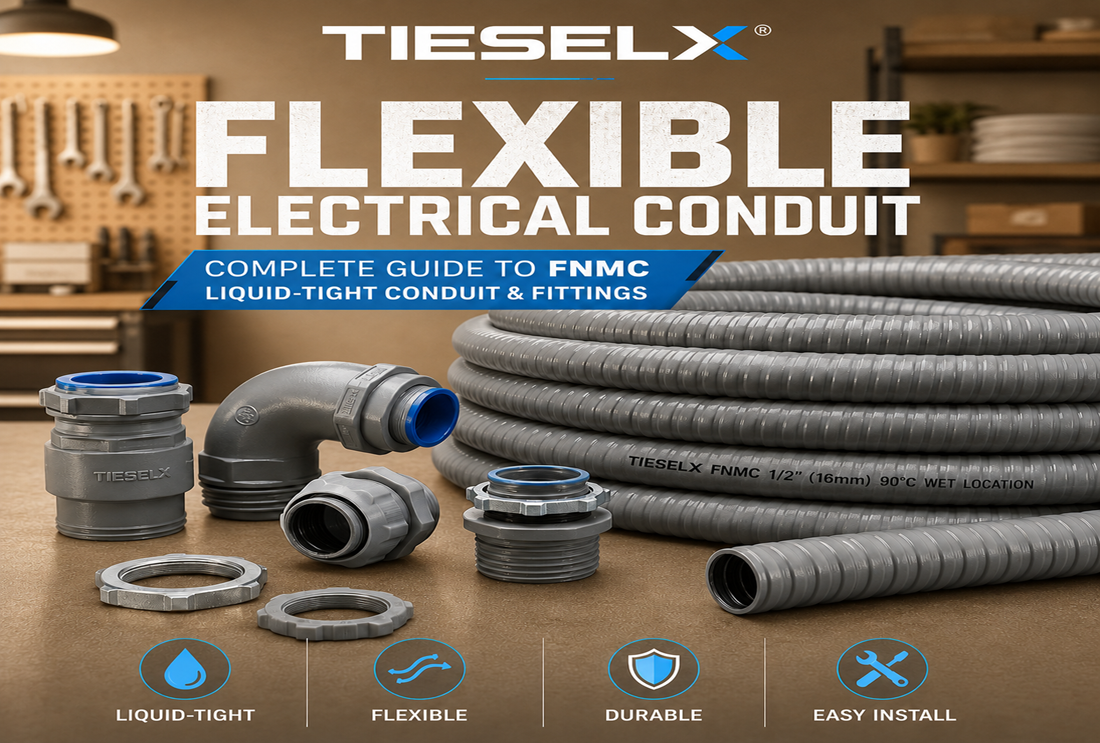
Electrical conduit is one of the most important — and most misunderstood — components of a professional electrical installation. Whether you’re a licensed electrician, a competent DIYer, or a facility manager overseeing an industrial build-out, choosing the right type of conduit and installing it correctly is essential for safety, compliance, and long-term reliability.
This guide covers everything you need to know about flexible non-metallic liquid-tight conduit (FNMC) — what it is, when to use it, how to install it, and how it compares to rigid conduit and other wire protection options.
What Is Flexible Non-Metallic Conduit?
Flexible non-metallic conduit — also called FNMC, flex conduit, or liquid-tight flexible conduit — is a corrugated PVC tube used to route and protect electrical wiring. Unlike rigid conduit (EMT, PVC Schedule 40, or IMC), it can be bent, curved, and routed through tight spaces without the need for separate elbows or bends. Unlike cable raceways and cable sleeves, it provides genuine mechanical and weather protection suitable for outdoor, wet, and industrial applications.
The “liquid-tight” designation means the conduit, when fitted with the correct liquid-tight conduit fittings, creates a waterproof seal at every connection point. This makes it the preferred choice for any installation that may be exposed to rain, condensation, irrigation water, or industrial liquids.
FNMC vs. Rigid Conduit: When to Use Each
| Feature | Flexible Non-Metallic Conduit (FNMC) | Rigid PVC Conduit (EMT / Sched 40) |
|---|---|---|
| Flexibility | Highly flexible — bends by hand | Rigid — requires elbows for bends |
| Weight | 50% lighter than metal conduit | Heavy (metal), moderate (PVC) |
| Installation speed | Fast — cut to length, no special fittings for bends | Slower — requires measuring and fitting elbows |
| Vibration tolerance | Excellent — absorbs motor vibration | Poor — rigid joints can loosen |
| UV resistance | UV resistant (black FNMC) | UV resistant (grey PVC Sch40) |
| Direct burial | Rated for direct burial | PVC Schedule 40/80 rated for burial |
| Cost | Lower cost per foot | Higher, especially for fittings |
| Best use | Final connections, vibrating equipment, tight spaces | Long straight runs, structural installations |
When Should You Use Liquid-Tight Flexible Conduit?
Flexible liquid-tight conduit is the right choice in the following situations:
- HVAC equipment connections: The most common application. Air conditioners, heat pumps, and air handlers all require a flexible “whip” connection between the fixed rigid conduit and the unit itself, which vibrates during operation. Rigid conduit joints would loosen over time; flexible conduit accommodates the movement.
- Motor and pump connections: Industrial motors, water pumps, pool pumps, and sump pumps all benefit from a flexible liquid-tight final connection.
- Outdoor electrical equipment: Post-mounted lights, security cameras, outdoor sockets, irrigation controllers, and EV chargers all need weatherproof wiring protection. FNMC resists rain, UV, and temperature extremes.
- Solar panel installations: DC wiring from panels to inverters, and AC connections from inverters to the main panel, are often run in FNMC where exposed to weather.
- Underground direct burial: FNMC is rated for direct burial. It protects wiring against moisture ingress, soil movement, and insect damage.
- Refrigeration and cold storage: FNMC stays flexible at very low temperatures, unlike some rigid plastics that become brittle in freezing conditions.
Understanding Conduit Fittings
Conduit fittings create the connection between the flexible conduit and the electrical box, panel, or equipment enclosure. For liquid-tight installations, the fitting must create a waterproof seal — not just a mechanical connection. There are two main types included in our TIESELX Conduit Kit:
- Straight (180°) fittings: The conduit enters the fitting and box from the same direction. Used for straight-on connections. Can be used for buried connections.
- 90-degree angle fittings: The conduit approaches the box from the side, and the fitting creates a 90° turn into the knockout. Used in tight enclosures where there isn’t room for the conduit to approach straight on.
Installation requires no tools for the conduit-to-fitting connection. Push the conduit end firmly onto the ferrule inside the fitting body, then hand-tighten the dome sealing nut. The nut compresses an internal gasket to form a liquid-tight seal. Threading the fitting into the box knockout may require a locknut, which is typically included or available separately.
How to Size Conduit for Your Wiring
Conduit sizing is determined by the number and gauge of conductors being routed through it, subject to NEC conduit fill limits (maximum 40% fill for 3+ conductors). As a practical guide for 1/2-inch conduit (the most common size for residential and light commercial work):
| Wire Gauge | Max Conductors in 1/2″ FNMC | Typical Application |
|---|---|---|
| 14 AWG THHN | 4 conductors | 15A circuits, lighting |
| 12 AWG THHN | 3 conductors | 20A circuits, HVAC, general outlets |
| 10 AWG THHN | 2 conductors | 30A circuits, dryers, AC units |
| 8 AWG THHN | 1–2 conductors | 40–50A circuits, ranges, large AC |
Always verify fill calculations against NEC Article 358 and your local electrical authority’s requirements before installation.
Step-by-Step Installation
- Plan your route. Identify the start and end points of your conduit run. Measure the required length, adding 6–12 inches for fitting depth and any slack needed for service loops.
- Cut the conduit. Use a utility knife, PVC cutter, or hacksaw. Cut cleanly through the conduit wall and deburr if needed.
- Pull your conductors. Thread the required wires through the conduit before attaching fittings. Use wire-pulling lubricant for longer runs or more conductors.
- Install straight fittings at each end. Push the conduit firmly onto the ferrule inside the fitting until it reaches the stop. Hand-tighten the dome nut to create the liquid-tight seal.
- Mount the fittings to boxes. Thread the fitting body into the box knockout. Secure with a locknut tightened inside the box if required. Ensure the sealing gasket between fitting and box is tight.
- Secure the conduit run. Clamp the conduit to the surface using conduit straps at intervals required by your local code (typically maximum 4.5 feet apart, within 12 inches of each box).
- Make your electrical connections. Connect conductors to terminals per your wiring diagram. Keep the work area de-energized until inspection is complete.
TIESELX Flexible Conduit Kit: What’s Included
Our TIESELX 1/2 Inch Flexible Liquid-Tight Conduit Kit is a complete solution that includes everything needed for a professional installation in one package:
- 25 feet of 1/2-inch FNMC liquid-tight conduit
- 5 × straight (180°) conduit connector fittings
- 3 × 90-degree angle conduit connector fittings
The conduit is manufactured from high-quality PVC with a smooth interior for clean wire pulling. It resists corrosion, water, oil, UV radiation, acid, and abrasion. At 50% lighter than metallic conduit, it’s significantly easier to handle and install, especially when working at height or in tight spaces.
Browse all available conduit products in our Conduits & Fittings section, or return to the full Cable Management range to find the complete solution for your project.
Frequently Asked Questions
Is flexible conduit approved by the NEC?
Yes. Flexible non-metallic conduit (FNMC) is covered under NEC Article 356. It is a recognised wiring method for many applications. Always confirm with your local authority having jurisdiction (AHJ) for specific installation requirements in your area.
What is the maximum length of flexible conduit allowed?
NEC 356.60 generally limits flexible conduit lengths to 6 feet at equipment connections where it serves as the final connection to equipment that requires flexibility. For longer runs used as the primary wiring method, there is no length limit, but support intervals must be maintained. Check with your AHJ.
Can I use non-metallic conduit indoors?
Yes. FNMC can be used indoors and outdoors. Indoors, it’s commonly used to make final connections to equipment in mechanical rooms, utility rooms, and commercial kitchens where flexibility and moisture resistance are needed.
Related products: split wire loom tubing and heat shrink tubing.