
Stainless Steel Zip Ties
for Industrial & Outdoor Use
Premium stainless steel zip ties designed for extreme strength, corrosion resistance, and secure cable fastening in industrial applications.
Secure cables, wiring, hoses, and equipment with TIESELX stainless steel zip ties. Made from corrosion-resistant 304 stainless steel, these metal cable ties provide a strong, lasting hold for outdoor, automotive, electrical, and industrial applications.
Unlike standard plastic ties, stainless steel withstands prolonged sunlight exposure and performs well in demanding environments where heat, moisture, and vibration can affect conventional fastening materials.
Explore our self-locking stainless steel cable ties, designed for dependable bundling and straightforward installation.
Shop TIESELX Stainless Steel Zip Ties
Showing the single result
-
Stainless Steel Zip Ties
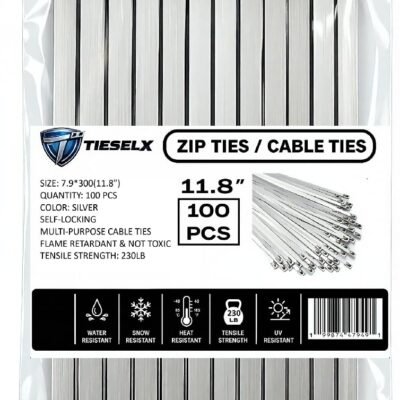
Stainless Steel Zip Ties 100 Pack – 11.8 Inch Heavy Duty 304 Stainless Cable Ties, 230 LBS Tensile, Self-Locking
$12.99
Why Choose Stainless Steel Zip Ties?
Stainless steel cable ties are designed for jobs that need more than everyday cable organization. Their metal construction offers a practical combination of mechanical strength, weather resistance, and secure fastening.
Corrosion-Resistant 304 Stainless Steel
TIESELX metal zip ties are manufactured from 304 stainless steel, which provides reliable corrosion resistance in many indoor and outdoor environments.
They are suitable for general industrial installations, outdoor equipment, utility areas, and locations exposed to changing weather conditions.
For continuous saltwater exposure or particularly aggressive chemical environments, 316 stainless steel may be a better choice.
Strong, Self-Locking Fastening
The integrated ball-lock mechanism grips the steel strap as it is tightened, helping maintain a secure connection without a separate buckle.
Our current 11.8-inch stainless steel cable ties have a listed tensile rating of 230 lb, making them a practical option for demanding cable bundling and general fastening applications.
Built for Outdoor Conditions
Stainless steel does not deteriorate under UV exposure in the same way as ordinary nylon. It is a useful choice for outdoor electrical installations, exposed equipment, fencing, and other applications where weather resistance matters.
Suitable for Higher Temperatures
Metal cable ties tolerate heat better than conventional nylon ties, making them useful around machinery, automotive components, and industrial equipment.
Always check the temperature requirements of the complete installation, including cable insulation, surrounding materials, and any applicable fastening standards.
A Durable Fastening Solution
When correctly selected and installed, stainless steel ties can provide lasting cable restraint with minimal maintenance. Their combination of strength and environmental resistance makes them useful for applications where frequent replacement would be inconvenient.
Where Can You Use Stainless Steel Cable Ties?
Metal cable ties support a range of professional and everyday fastening tasks.
- Automotive and exhaust systems: Secure suitable heat-resistant wraps, wiring, and components away from moving parts and excessive clamping pressure.
- Electrical installations: Bundle and organize cables where metal fasteners are permitted and cable insulation is adequately protected.
- Solar panel installations: Manage exposed cables and wiring routes using approved mounting methods.
- HVAC systems: Secure suitable insulation, duct accessories, and cable bundles.
- Outdoor fencing and signage: Fasten compatible materials where a durable, weather-resistant connection is needed.
- Industrial equipment: Organize hoses, wires, and cable runs around machinery subject to vibration or temperature changes.
- Marine environments: Use for appropriate above-water applications while assessing salt exposure and corrosion requirements.
For routine indoor wire organization, nylon cable ties may provide a more economical solution.
How to Choose the Right Stainless Steel Zip Ties
The best metal zip tie is not necessarily the widest or strongest option. The correct choice depends on bundle size, material grade, operating conditions, and how the tie contacts the secured surface.
1. Choose the Right Stainless Steel Grade
Two common stainless steel grades used in cable ties are 304 and 316.
| Feature | 304 stainless steel | 316 stainless steel |
|---|---|---|
| General corrosion resistance | Good | Very good |
| Indoor industrial use | Suitable | Suitable |
| General outdoor use | Suitable | Suitable |
| Coastal or saltwater exposure | More susceptible to chloride corrosion | Better resistance |
| Typical cost | More economical | More expensive |
TIESELX currently offers a 304 stainless steel option, suitable for many general-purpose industrial and outdoor fastening jobs.
For marine or chloride-rich environments, evaluate the conditions carefully before choosing a grade.
2. Check the Length and Width
Cable tie length determines the circumference that can be secured, while strap width influences how clamping force is distributed.
Our 11.8-inch stainless steel zip ties are 300 mm long and 7.9 mm wide.
Measure the complete bundle circumference and allow additional length for threading, tightening, and the locking head. Verify the maximum bundle diameter against the product specifications.
3. Understand Tensile Strength
Tensile strength describes the force a cable tie can withstand under specified test conditions.
The listed 230 lb tensile rating of our stainless steel zip ties refers to the tie’s fastening strength. It is not a certified working load or lifting capacity.
Never use standard metal zip ties for overhead lifting, fall protection, or load-bearing suspension in place of approved hardware.
4. Consider Coated or Uncoated Designs
Uncoated stainless steel ties provide direct metal fastening and are commonly used for industrial applications.
Coated stainless steel ties add a protective layer that can help reduce abrasion against cable jackets or delicate surfaces. However, coating material and temperature limitations vary by product.
Our current stainless steel zip ties are an uncoated metal design. Avoid overtightening them around sensitive insulation.
How to Install Stainless Steel Zip Ties
Proper installation helps maintain a secure hold while reducing the risk of damaging cables or leaving sharp metal edges.
- Measure the bundle. Check that the cable tie is long enough to wrap around the items being secured.
- Position the tie. Wrap the metal strap around the bundle, keeping it flat and free from twists.
- Engage the lock. Insert the narrow end through the self-locking head in the correct direction.
- Apply tension. Pull the strap until snug. For consistent results, use a compatible stainless steel cable tie tensioning tool.
- Trim the excess. Cut the remaining strap with an appropriate metal-cutting tool and ensure the exposed end cannot cause injury.
Wear protective gloves when handling cut metal straps. Avoid excessive tension around electrical cables, soft hoses, or other materials that could be crushed.
Stainless Steel vs. Nylon Zip Ties: Which Is Better?
Both fastening materials have advantages. The better option depends on the installation rather than strength alone.
| Consideration | Stainless steel zip ties | Nylon zip ties |
|---|---|---|
| Material | Corrosion-resistant metal | Engineering-grade plastic |
| Sunlight exposure | Excellent resistance | Requires UV-stabilized material |
| Heat resistance | Generally higher | Lower, grade-dependent |
| Flexibility | Less flexible | More flexible |
| Cost | Typically higher | More economical |
| Typical applications | Industrial, outdoor, high-heat | Home, office, general wiring |
Choose stainless steel when exposure to heat, weather, or mechanical stress makes metal fastening advantageous.
For general cable organization, explore our heavy-duty nylon zip ties or UV-resistant zip ties.
For a closer look at the differences, read our stainless steel vs. nylon zip ties comparison.
Shop TIESELX Heavy-Duty Stainless Steel Zip Ties
Looking for reliable metal fastening without complicated installation?
Our TIESELX 304 Stainless Steel Zip Ties feature a self-locking ball mechanism and a corrosion-resistant steel strap.
Product specifications
| Specification | Details |
|---|---|
| Material | 304 stainless steel |
| Length | 11.8 inches (300 mm) |
| Width | 7.9 mm |
| Listed tensile strength | 230 lb |
| Locking mechanism | Self-locking ball |
| Finish | Silver, uncoated |
| Package quantity | 100 ties |
| Primary applications | Industrial, automotive, electrical, and outdoor fastening |
Whether you’re working on industrial cable management, outdoor equipment, or vehicle maintenance, select a fastening solution suited to your installation conditions.
Frequently Asked Questions About Stainless Steel Zip Ties
Are stainless steel zip ties stronger than plastic zip ties?
Stainless steel zip ties generally offer greater heat resistance and can provide higher tensile strength than standard nylon ties. However, strength depends on the specific product, dimensions, and locking design. Compare the listed ratings rather than assuming every metal tie is stronger than every nylon tie.
Do stainless steel cable ties rust?
Stainless steel resists corrosion but is not completely rustproof. Grade 304 performs well in many everyday environments, while grade 316 offers better resistance to chloride-related corrosion. Saltwater exposure, chemical contact, and maintenance conditions can all affect service life.
Can stainless steel zip ties be used outdoors?
Yes. Stainless steel zip ties are suitable for many outdoor applications because they resist UV exposure and weather-related deterioration. Select the appropriate steel grade and fastening design based on local environmental conditions.
Can metal zip ties be used on electrical cables?
Yes, where permitted by the installation requirements. Avoid direct contact with sensitive insulation, do not overtighten, and ensure the fastening system is suitable for the electrical application. Metal cable ties are not a substitute for insulation or electrical grounding.
Can stainless steel zip ties withstand high temperatures?
Stainless steel generally tolerates higher temperatures than conventional nylon. However, the complete tie assembly, locking mechanism, and surrounding materials must be suitable for the operating temperature. Check the relevant product specifications before use near exhaust systems or other high-heat equipment.
Are stainless steel zip ties reusable?
Most standard self-locking stainless steel zip ties are intended for permanent, single-use fastening. Removal usually requires cutting the strap. For installations requiring frequent access, consider a purpose-designed reusable fastening system.
Do I need a special tool to install stainless steel zip ties?
Some stainless steel zip ties can be tightened by hand, but a compatible tensioning tool provides better control and more consistent results. A suitable metal-cutting tool is also recommended for safely trimming excess material.
What is the difference between 304 and 316 stainless steel cable ties?
Grade 304 is a practical choice for many indoor, outdoor, and industrial applications. Grade 316 contains molybdenum, which improves resistance to chloride-related pitting corrosion. This makes 316 worth considering for coastal, marine, and more corrosive environments.
How much weight can stainless steel zip ties hold?
Strength varies by design and size. The TIESELX 11.8-inch stainless steel zip ties have a listed tensile rating of 230 lb. This rating describes fastening strength under test conditions and should not be interpreted as an approved suspended working load.
Learn more in our zip tie tensile strength guide.
Explore More Cable Ties and Installation Guides
The right fastening material helps protect cables, simplify installation, and improve the long-term reliability of your project.
Browse our black zip ties for everyday outdoor bundling, or explore our bulk zip ties selection for larger projects.
Need help with a specific installation? Our solar panel cable management guide explains fastening choices for exposed wiring, while our cable management buying guide covers tie materials, sizes, and applications.
At TIESELX, we make it easier to choose practical fastening solutions for your work.