
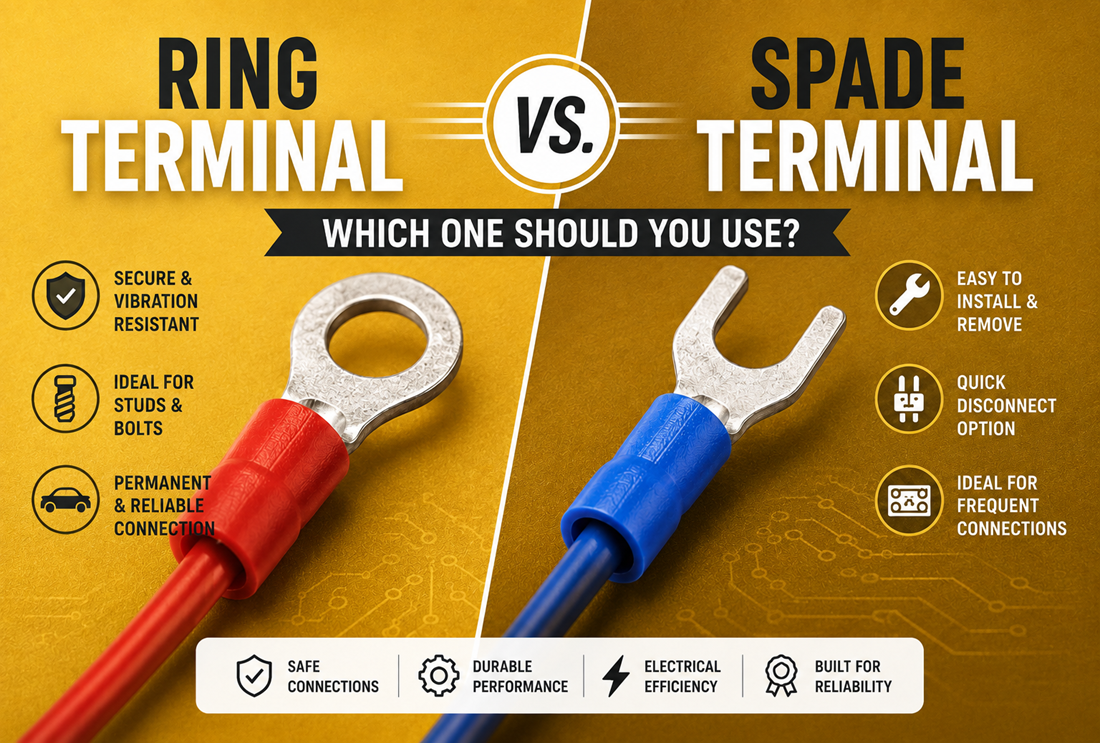
Ring terminals and spade terminals both crimp onto a wire and attach to a screw or stud — but they attach in very different ways, and that difference decides which one belongs on your project. A ring terminal locks on with a closed loop. A spade terminal slides on and off with an open fork. Get the choice right and your connection holds up and stays easy to service.
This guide compares the two side by side: how each connects, how installation differs, where each one shines, and how to pick based on your wire gauge, environment, and how often you’ll service the joint.
Quick answer
- Choose a ring terminal when the connection must not come loose — battery posts, ground straps, and any bolted joint exposed to vibration. The closed loop can’t slip off the stud.
- Choose a spade (fork) terminal when you want speed and easy service — terminal blocks, control panels, and screw terminals you rewire often. The open fork slides out without removing the screw.
Neither is universally better. The right pick depends on the application.
A quick note on terminology: “spade terminal” usually means the open fork style that slides under a screw, and that’s how this guide uses it. Some people also call the push-on male/female quick-disconnect blades “spade connectors.” This comparison is about the fork-style spade that attaches to a screw or stud, versus the ring terminal.
What is a ring terminal?
A ring terminal ends in a closed circular loop with a hole in the center. The wire crimps into a barrel on the other end.
To install it, you pass a screw or threaded stud through the loop and tighten a nut or screw down on top. Because the loop fully surrounds the fastener, the terminal stays put even if the fastener backs off slightly.
Ring terminals come in a range of stud-hole diameters (the size of the loop’s hole) and wire-barrel sizes, so you match both to your hardware and your wire.
Browse the full range of ring terminals, or find them in the TIESELX Wire Terminals & Connectors Kit.
What is a spade terminal?
A spade — or fork — terminal ends in an open, U-shaped prong instead of a closed loop. The wire crimps into a barrel just like a ring terminal.
To install it, you loosen the screw (without removing it), slide the open fork around the screw shaft, and retighten. To remove it, you loosen the screw again and slide the fork straight out. There’s no need to take the fastener all the way off.
That open end is the whole point: it makes the spade terminal fast to connect and disconnect on screw terminals. Browse the full range of spade terminals.
How each connects to a screw or stud
| Step | Ring terminal | Spade (fork) terminal |
|---|---|---|
| Fastener removal | Remove the nut/screw completely | Only loosen the screw |
| Placement | Slip loop over the stud | Slide fork around the screw |
| Result | Fastener captures the closed loop | Screw head clamps the open fork |
| Removal | Remove fastener again | Loosen and slide out |
The core trade-off is right there: the ring captures the fastener, the spade slides past it. Capturing is more secure; sliding is faster.
Installation differences
Ring terminal
– Requires full access to remove and replace the nut or screw.
– Takes a little longer, especially on multi-stud blocks.
– Rewards you with a joint that won’t shake loose.
Spade terminal
– Only needs the screw loosened, so it’s quick on crowded terminal strips.
– Lets you add or swap a wire without disturbing neighbors.
– Depends on the screw staying tight to hold position.
For both, a clean crimp with the correct tool matters as much as the attachment style. A poorly crimped ring is no better than a poorly crimped fork.
Advantages and limitations
Ring terminal
Advantages
– Most secure of the two — the loop can’t slip off
– Handles vibration well
– Large, stable contact area against the stud
Limitations
– Slower to install and remove
– Needs the fastener fully removed for service
Spade terminal
Advantages
– Fast to install and remove
– No need to remove the fastener
– Ideal for connections you revisit often
Limitations
– Can slide out if the screw loosens
– Less suited to high-vibration or safety-critical joints
When a ring terminal is the better choice
Pick a ring terminal when security matters more than speed:
- Battery and power connections — posts, distribution blocks, and bus bars.
- Ground straps and chassis grounds — where a lost connection is a real hazard.
- High-vibration environments — vehicles, equipment, and machinery.
- Set-and-forget joints — connections you rarely need to open.
When a spade terminal is the better choice
Pick a spade terminal when access and speed matter most:
- Terminal blocks and barrier strips — slide wires in and out quickly.
- Control panels and enclosures — where you troubleshoot and rewire.
- Equipment you service often — anything you expect to open again.
- Crowded strips — swap one wire without removing the whole stack.
Maintenance considerations
- Ring terminals rarely need attention once torqued down, which is part of their appeal. When you do service them, inspect the stud and terminal for corrosion, especially on battery and outdoor connections.
- Spade terminals are easy to re-seat, but check periodically that the screw is still tight — a loose screw is the main way a fork terminal fails.
- For either type in damp or outdoor settings, consider heat-shrink or sealed versions and keep the metal clean to limit corrosion.
Wire gauge considerations
Both ring and spade terminals must match your wire gauge at the barrel. The insulated versions typically follow a common color convention:
| Sleeve color | Common wire-gauge range* |
|---|---|
| Red | ~22–16 AWG |
| Blue | ~16–14 AWG |
| Yellow | ~12–10 AWG |
*Color coding is a common convention, not a universal standard. Always confirm the rated wire range on the packaging before crimping.
For ring terminals, you also match the stud-hole size to your bolt or screw. For spade terminals, match the fork width to the screw so the prongs seat properly without being too tight or too loose. If you want the full breakdown of matching wire to terminal, see the wire-gauge and terminal-size guide in this series.
Insulated vs. non-insulated versions
Both styles come insulated or non-insulated.
- Insulated terminals have a colored sleeve that guards against shorts and signals the gauge range. Use these for most general wiring.
- Non-insulated terminals are bare metal, used where a separate insulator, boot, heat-shrink, or enclosure covers the joint.
For outdoor, marine, or washdown environments, a heat-shrink version of either terminal adds a moisture-resistant seal. Pair it with adhesive-lined tubing from the TIESELX Heat Shrink Tubing Kit when needed.
Comparison table: ring terminal vs. spade terminal
| Feature | Ring terminal | Spade (fork) terminal |
|---|---|---|
| End shape | Closed loop | Open U/fork |
| Attaches by | Fastener through the loop | Sliding under a loosened screw |
| Security | Highest — can’t slip off | Good, but can slide out if loose |
| Vibration resistance | Strong | Moderate |
| Install/remove speed | Slower | Faster |
| Fastener removal needed | Yes, fully | No, just loosen |
| Best for | Battery, ground, bolted power joints | Terminal blocks, panels, frequent service |
| Match to hardware | Wire gauge + stud-hole size | Wire gauge + fork width |
Practical examples
- Car battery ground strap: Use a ring terminal. It bolts to the chassis and must survive constant vibration without loosening.
- Control panel terminal strip: Use spade terminals. You’ll add, remove, and trace wires many times, and speed wins.
- Marine bus bar: Use a ring terminal, ideally heat-shrink sealed, for a secure connection that resists both vibration and moisture.
- Home audio amplifier’s screw terminals: A spade terminal slides on quickly and comes off just as easily when you upgrade gear.
Ring Terminal or Spade Terminal: Quick Decision Guide
Answer these in order:
- Will the joint see vibration or is it safety-critical (battery, ground)? → Ring terminal.
- Will you service or rewire it often? → Spade terminal.
- Is the stud a bolt you’d rather not fully remove each time? → Spade terminal, if vibration is low.
- Is it a permanent power connection you’ll rarely touch? → Ring terminal.
- Still unsure? → Default to a ring terminal for security, unless quick access is clearly the priority.
Buying guide
- Match the barrel to your wire gauge using the color convention, then confirm the rated range on the packaging.
- For rings, match the stud-hole size to your bolt or screw diameter.
- For spades, match the fork width to the screw.
- Keep both on hand. A mixed assortment covers most jobs — the TIESELX Wire Terminals & Connectors Kit includes ring, fork, and spade styles across common sizes.
- Add heat-shrink versions for anything outdoors or in a vehicle.
- Use the right crimp tool — a ratcheting crimper sized for insulated terminals gives consistent results.
- Browse the full Wire Terminals & Connectors range to compare options.
Safety note
Always disconnect power before working on a circuit — never work on energized wiring. For household AC wiring or anything you’re unsure about, consult a licensed electrician and follow local codes. Torque battery and power connections per the equipment manufacturer’s guidance.
Frequently asked questions
What is the main difference between a ring terminal and a spade terminal?
A ring terminal has a closed loop that a bolt or stud passes through, so it can’t slip off. A spade (fork) terminal is open on one side and slides under a loosened screw, making it faster to install and remove but easier to dislodge if the screw loosens.
Is a ring terminal more secure than a spade terminal?
Generally yes. Because the loop fully surrounds the fastener, a ring terminal resists vibration and won’t slide off. A spade terminal relies on the screw staying tight, so it’s less suited to high-vibration or safety-critical joints.
When should I use a spade terminal instead of a ring terminal?
Use a spade terminal on screw terminals you service often — terminal blocks, control panels, and audio gear — where you want to add or remove a wire quickly without taking the fastener all the way out.
Do ring and spade terminals use the same wire gauges?
Yes. Both come in the same common gauge ranges and often follow the same red/blue/yellow color convention. Match the terminal to your wire gauge, and always confirm the rated range on the packaging.
Can I use a spade terminal on a battery post?
It’s not recommended. Battery and ground connections see vibration and carry high current, so a ring terminal’s secure, closed-loop attachment is the safer choice.
Are insulated ring and spade terminals better than non-insulated?
Neither is universally better. Insulated terminals give a fast, protected joint for most wiring. Non-insulated versions suit connections already covered by an insulator, boot, or enclosure.
Conclusion
The ring terminal vs. spade terminal decision comes down to security versus speed. A ring terminal’s closed loop makes it the choice for battery, ground, and high-vibration connections that must never come loose. A spade terminal’s open fork makes it the choice for terminal blocks and panels you service often. Match either one to your wire gauge and hardware, crimp it properly, and you’ll have a reliable connection.
Explore both styles in the Wire Terminals & Connectors range and pick the attachment that fits how your connection will live.