
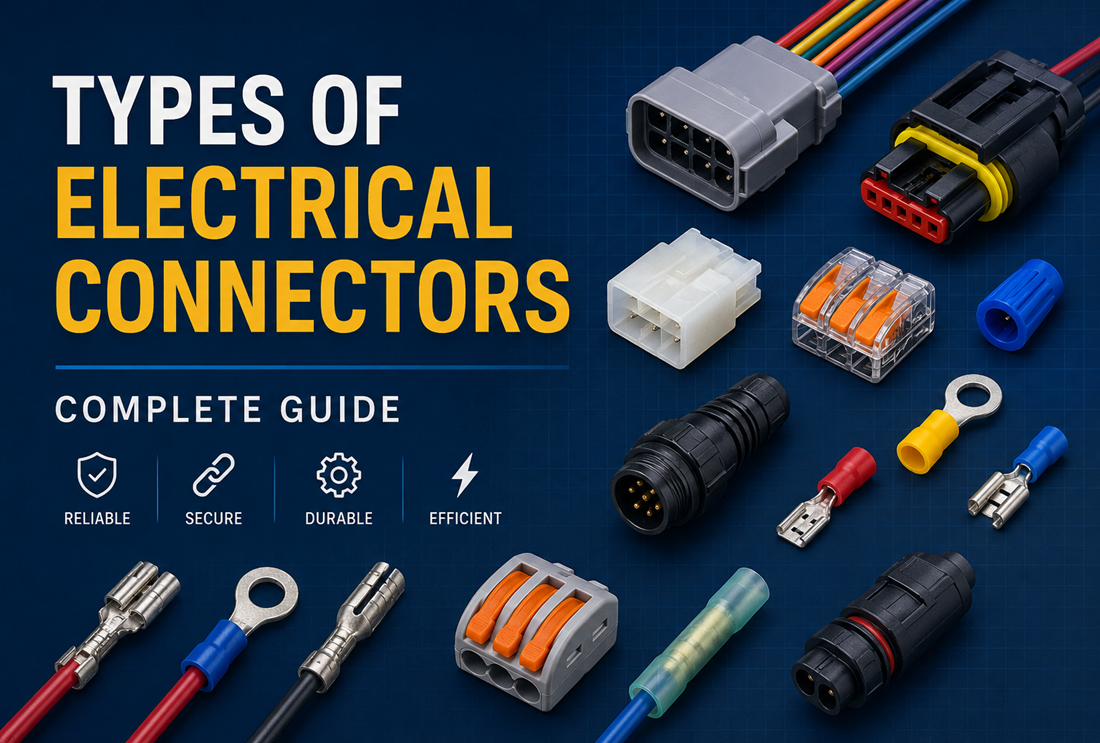
Electrical connectors and wire terminals are the small metal fittings that turn a bare wire into a safe, reliable connection point. Choose the right one and a circuit goes together quickly, holds up under vibration, and comes apart cleanly for service. Choose the wrong one and you get loose joints, overheating, and connections that fail when you least expect it.
This guide walks through the major types of electrical connectors used in low-voltage DIY, automotive, marine, and general wiring work. For each type you’ll learn what it is, how it works, where it’s used, its strengths and limits, and when to reach for it. A comparison table and a practical selection section at the end tie everything together.
Quick answer: the main types at a glance
If you only remember a handful of connector families, make it these:
- Ring terminals — a closed loop that bolts down under a screw or stud; the most secure, won’t slip off.
- Spade (fork) terminals — an open U-shape that slides under a loosened screw; fast to install and remove.
- Quick-disconnect terminals — male and female “blade” halves that push together and pull apart by hand.
- Butt connectors — a sleeve that joins two wires end to end into one continuous run.
- Bullet connectors — round male and female pins for a compact push-together joint.
- Pin (needle) terminals — a solid pin end for inserting into screw or clamp terminal blocks.
Most of these come in insulated and non-insulated versions, plus a heat-shrink style for moisture protection. The right choice depends on how the connection attaches, the wire gauge, and the environment. The rest of this guide fills in the detail.
Connectors, terminals, and wire connectors: what’s the difference?
People use these words loosely, and that’s fine in conversation. It helps to know how they’re generally meant:
- A wire terminal attaches to the end of a single wire so it can connect to something else — a stud, a screw, a blade, or another terminal. Ring, spade, and quick-disconnect terminals are all wire terminals.
- An electrical connector is the broader term for any device that joins conductors or lets them connect and disconnect. Terminals are a type of connector, but so are multi-pin plugs, bullet connectors, and butt splices.
- A wire connector often refers specifically to devices that join wires together — such as butt connectors that splice two wires, or twist-on connectors used in building wiring.
In short: every terminal is a connector, but not every connector is a terminal. This guide focuses on the crimp-on terminals and inline connectors used most often in 12V and low-voltage wiring. You can browse the full range in the Wire Terminals & Connectors category.
Ring terminals
What it is
A ring terminal ends in a closed circular loop with a hole sized for a screw or threaded stud. The wire crimps into the barrel at the other end.
How it works
You slide the ring over a bolt or stud, then tighten a nut or screw down on top. Because the loop is closed, the connection can’t slip off even if the fastener loosens slightly.
Common applications
- Battery terminals and grounding points
- Automotive and marine power connections
- Distribution blocks, bus bars, and fuse panels
- Any bolted joint that must not come loose
Advantages
- The most secure attachment of the common terminals — vibration-resistant
- Large contact area against the stud
- Available in many stud-hole and wire sizes
Limitations
- You must fully remove the nut or screw to install or remove it
- Slower to service than a fork or quick-disconnect terminal
When to choose it
Pick a ring terminal for permanent or safety-critical bolted connections, especially where vibration is a factor — battery leads, chassis grounds, and power feeds are classic examples.
Shop the full range of ring terminals, or start with the TIESELX Wire Terminals & Connectors Kit, which includes ring connectors.
Spade and fork terminals
What it is
A spade terminal (also called a fork or split ring terminal) ends in an open U-shaped prong instead of a closed loop.
How it works
You loosen — but don’t fully remove — the screw, slide the open fork around it, and retighten. The open end lets you install and remove the terminal without taking the fastener all the way out.
Common applications
- Terminal blocks and barrier strips
- Control panels and electrical enclosures
- Audio and equipment wiring you service often
- Screw terminals where speed matters
Advantages
- Faster to install and remove than a ring terminal
- No need to remove the fastener completely
- Ideal for connections you revisit or rewire
Limitations
- Can slip out from under the screw if it loosens — less vibration-tolerant than a ring
- Not the best choice for high-vibration or safety-critical joints
When to choose it
Use a fork terminal on screw terminals you service regularly, such as control panels and terminal strips, where quick access matters more than maximum grip. Explore the full range of spade terminals.
Quick-disconnect terminals (male and female spades)
What it is
Quick-disconnect terminals — often just called spade connectors in automotive use — come as a matched male tab and female receptacle that push together to make a connection you can undo by hand.
How it works
You crimp a female terminal on one wire and a male terminal on the other (or the male half plugs onto a device’s blade tab). Push them together to connect; pull them apart to disconnect. No tools needed once they’re crimped.
Common tab widths include 2.8 mm, 4.8 mm, and 6.3 mm — match the male and female halves to the same size so they seat properly.
Common applications
- Automotive switches, relays, and 12V accessories
- Speaker and car-audio wiring
- Appliance repair
- Any circuit that needs to come apart for service
Advantages
- Connect and disconnect by hand, repeatedly, without cutting wire
- Fast to service and troubleshoot
- Widely standardized tab sizes
Limitations
- The push-on joint is less mechanically secure than a bolted ring terminal
- Can work loose under heavy vibration if the fit is poor or the size is mismatched
When to choose it
Reach for quick-disconnects whenever a low-voltage connection needs to be separated and reconnected — switches, relays, and speaker leads are typical. The TIESELX Insulated Spade Connectors cover male and female halves across common wire-gauge ranges. Browse the full range of quick-disconnect terminals.
Butt connectors
What it is
A butt connector is a small metal barrel inside an insulated sleeve, open at both ends. It joins two wires end to end.
How it works
You strip both wire ends, insert one into each side of the barrel until they meet the internal stop, and crimp each side. The result is a single continuous conductor with an insulated splice.
Common applications
- Extending or repairing a wire run
- Automotive, trailer, and 12V harness repairs
- Marine and RV circuits (use a sealed/heat-shrink style where moisture is a concern)
- Splicing speaker and equipment wiring
Advantages
- Cleaner and more reliable than twisting and taping
- Compact inline joint
- Available in standard color-coded gauge ranges
Limitations
- Creates a permanent splice — you cut it out to undo it
- Standard PVC-insulated versions are not sealed against water
When to choose it
Use a butt connector to permanently join or extend two wires end to end. For wet or outdoor locations, choose a heat-shrink/waterproof style instead. The TIESELX Insulated Butt Connectors come in the common red, blue, and yellow gauge ranges.
Bullet connectors
What it is
Bullet connectors use a rounded male pin and a matching female sleeve for a compact push-together inline joint.
How it works
Crimp a bullet terminal on each wire, then push the male pin into the female sleeve. Like a quick-disconnect, the joint separates by hand.
Common applications
- Motorcycle and older automotive wiring
- Turn signals, lighting, and small accessory circuits
- Connections in tight spaces where a flat blade won’t fit
Advantages
- Small, round profile fits confined runs
- Separates and reconnects by hand
- Common in powersports and vintage automotive harnesses
Limitations
- Less common than blade-style quick-disconnects, so matching hardware can be harder to source
- Push-on joint is not vibration-proof
When to choose it
Choose bullet connectors for compact, round inline connections you may need to separate — a good fit for motorcycle and small accessory wiring.
Pin terminals
What it is
A pin terminal (sometimes called a needle terminal) ends in a solid or flattened pin rather than a ring, fork, or blade.
How it works
You crimp the pin onto the wire and insert it into a screw-clamp or spring terminal block. The pin keeps stranded wire from splaying and gives the clamp a solid target to grip.
Common applications
- Terminal blocks and DIN-rail hardware
- Control and instrumentation wiring
- Anywhere stranded wire feeds into a screw or cage clamp
Advantages
- Keeps stranded conductors neat inside a clamp
- Improves contact in screw-terminal blocks
Limitations
- Only useful with matching terminal-block hardware
- Not a standalone connection on its own
When to choose it
Use pin terminals to terminate stranded wire that lands in a screw or clamp terminal block, so no strands escape the clamp.
Insulated vs. non-insulated terminals
Most terminal styles are sold in two forms.
Insulated terminals have a colored plastic or nylon sleeve over the crimp barrel. The sleeve protects the joint from accidental shorts and — by convention — signals the wire-gauge range the terminal fits.
A widely used color convention is:
| Sleeve color | Common wire-gauge range* |
|---|---|
| Red | ~22–16 AWG |
| Blue | ~16–14 AWG |
| Yellow | ~12–10 AWG |
*This color coding is a common industry convention, not a universal standard. Always confirm the exact rated wire range printed on the terminal’s packaging before crimping.
Non-insulated terminals are bare metal with no sleeve. They’re common where a separate insulator, heat-shrink, or an enclosure already covers the joint, and where you want to see the crimp directly.
Choose insulated terminals for most general wiring where a quick, protected joint is the goal. Choose non-insulated terminals when you’ll add your own insulation or when the connection sits inside a protective housing.
Heat-shrink terminals
What it is
A heat-shrink terminal is an insulated terminal whose sleeve is made from adhesive-lined heat-shrink tubing.
How it works
You crimp the terminal as usual, then apply heat with a heat gun. The sleeve shrinks tight around the wire and the adhesive melts to seal the joint against moisture.
Common applications
- Marine, outdoor, and RV wiring
- Automotive connections exposed to weather or washdown
- Any joint where moisture or corrosion is a concern
Advantages
- Adds a moisture-resistant, sealed finish
- Strain relief where the sleeve grips the wire jacket
- Cleaner look than adding separate tubing
Limitations
- Requires a heat source to seal properly
- Costs more than standard insulated terminals
When to choose it
Pick heat-shrink terminals whenever a connection sees moisture, salt, or weather. For splices, pair the idea with a heat-shrink butt connector, or add adhesive-lined tubing from the TIESELX Heat Shrink Tubing Kit.
Comparison table: common connector types
| Connector type | How it attaches | Reusable? | Best for | Key limitation |
|---|---|---|---|---|
| Ring terminal | Bolt/stud through a closed loop | Yes (remove fastener) | Battery, ground, bolted power joints | Slower to service |
| Fork/spade terminal | Slides under a loosened screw | Yes | Terminal blocks, panels | Can slip if screw loosens |
| Quick-disconnect | Male tab + female receptacle push together | Yes, by hand | Switches, relays, speakers | Push-on joint, less vibration-proof |
| Butt connector | Two wires crimped end to end | No (permanent splice) | Extending/repairing runs | Cut out to undo; PVC type not sealed |
| Bullet connector | Round pin into round sleeve | Yes, by hand | Motorcycle, tight spaces | Less common hardware |
| Pin terminal | Pin into a screw/clamp block | Depends on block | Terminal-block wiring | Needs matching block |
| Heat-shrink terminal | Any of the above, sealed sleeve | Depends on style | Wet/outdoor/marine | Needs a heat source |
How to choose the right connector
No single connector is best for every job. Work through these factors in order.
1. Match the connection type
Start with how the connection attaches. Use a ring for a bolted joint that must not come loose, a fork for a screw terminal you service often, a quick-disconnect for a push-on joint you’ll separate, and a butt connector to join two wires permanently.
2. Match the wire gauge
The terminal barrel must fit your conductor. A barrel that’s too large won’t grip the strands; one that’s too small won’t accept the wire fully. Use the color convention as a starting guide, then confirm the rated range on the packaging.
3. Consider the application and current
Higher-current circuits generally call for larger conductors and correspondingly larger terminals. Because rated capacities vary by product, match the terminal to the wire gauge the circuit already uses and follow the terminal manufacturer’s specification rather than guessing.
4. Account for the environment
For dry, indoor, or enclosed locations, standard insulated terminals are usually fine. For moisture, salt spray, vibration, or outdoor exposure, choose heat-shrink or sealed terminals — and ring terminals where vibration is high.
5. Decide on insulation
Use insulated terminals for a fast, protected joint. Use non-insulated terminals when a housing, boot, or separate heat-shrink will cover the connection.
6. Think about mechanical demands
If the joint sees pulling, flexing, or vibration, favor terminals with good strain relief (heat-shrink styles help) and secure attachment methods (rings over forks).
Common mistakes to avoid
- Using the wrong size terminal for the wire. This is the most common cause of loose, high-resistance joints. Match the barrel to the gauge.
- Relying on a fork terminal where a ring is needed. On a high-vibration or safety-critical bolt, use a ring.
- Choosing a standard PVC butt connector for a wet location. Use a heat-shrink/sealed style outdoors or in marine settings.
- Skipping the insulation check. A non-insulated terminal with no added protection can short against nearby metal.
- Assuming color equals a guaranteed rating. Color coding is a convention; always read the packaging for the exact rated range.
- Over- or under-crimping. A poor crimp undermines even the right terminal — use a proper crimp tool sized for the terminal type.
Buying guidance
When you’re stocking up, a few habits make wiring projects go smoothly:
- Buy an assortment first. A mixed kit of ring, fork, and spade terminals across common gauges covers most small jobs and helps you learn what you actually use. The TIESELX Wire Terminals & Connectors Kit is a practical starting point.
- Match colors to your wire. Keep red, blue, and yellow terminals on hand so you always have the right gauge range.
- Add heat-shrink options for anything outdoors. Sealed terminals or adhesive-lined tubing pay off in wet environments.
- Pair terminals with the right crimp tool. A ratcheting crimper sized for insulated terminals gives consistent results.
- Finish the run cleanly. Once connections are made, tidy the harness with zip ties, cable clips, and cable sleeves.
Safety note
Always disconnect power before working on a circuit — never work on energized wiring. For household AC wiring and any work you’re unsure about, consult a licensed electrician and follow local codes. This guide covers general low-voltage wiring concepts and is not a substitute for the manufacturer’s instructions for a specific terminal or device.
Frequently asked questions
What is the difference between a wire terminal and an electrical connector?
A wire terminal attaches to the end of a single wire so it can connect to a stud, screw, or blade. “Electrical connector” is the broader term for any device that joins or connects conductors, including terminals, butt splices, and multi-pin plugs. Every terminal is a connector, but not every connector is a terminal.
How do I know which connector size to use?
Match the terminal to your wire gauge. Insulated terminals often follow a color convention — red for smaller wire, blue for mid-range, yellow for heavier wire — but the exact acceptable range varies by manufacturer. Always confirm the rated wire range printed on the packaging before crimping.
What is the difference between a ring terminal and a spade terminal?
A ring terminal has a closed loop that a bolt or stud passes through, so it can’t slip off — best for secure, bolted joints. A spade (fork) terminal is open on one side and slides under a loosened screw, so it installs and removes faster but can slip out if the screw loosens.
When should I use a butt connector instead of a quick-disconnect?
Use a butt connector when you want to permanently join two wires end to end, such as extending or repairing a run. Use a quick-disconnect when you need to separate and reconnect the joint by hand, such as on a switch or relay.
Are insulated terminals better than non-insulated ones?
Neither is universally better. Insulated terminals give a fast, protected joint and are convenient for most wiring. Non-insulated terminals suit connections that will be covered by a separate insulator, heat-shrink, or enclosure. Choose based on whether the joint already has protection.
Do I need a special tool to install these connectors?
Most crimp terminals need a crimping tool sized for the terminal type. A ratcheting crimper gives the most consistent result. Heat-shrink terminals also require a heat gun to seal the sleeve.
Conclusion
The many types of electrical connectors come down to a few decisions: how the connection attaches, what wire gauge you’re using, and what environment the joint lives in. Ring terminals lock down bolted joints, fork terminals speed up screw connections, quick-disconnects let circuits come apart by hand, and butt connectors splice wires into one run — with insulated, non-insulated, and heat-shrink options layered on top.
Get those choices right and match each terminal to your wire and application, and your connections will be safer, cleaner, and far more reliable. Browse the full Wire Terminals & Connectors range to find the type and size that fits your project.