
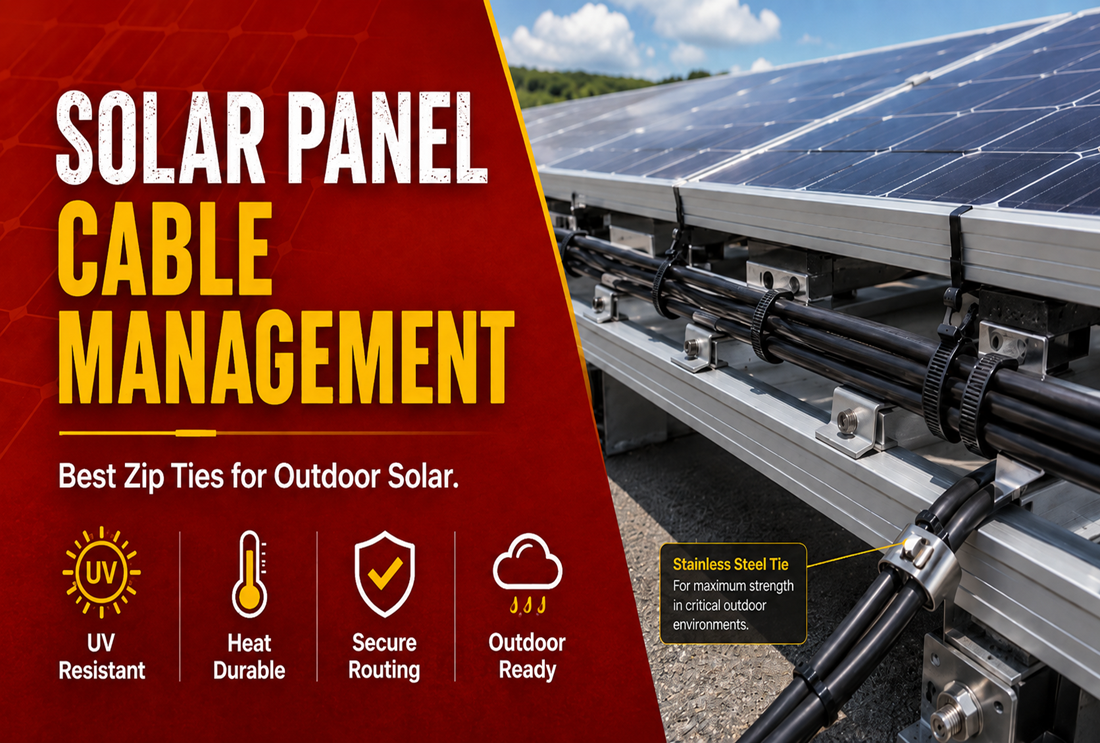
Solar panels are built to work outdoors for decades — most carry performance warranties of around 25 years. The problem is that the small parts holding your wiring in place rarely get the same attention. A cheap cable tie that turns brittle and snaps after two summers can leave a PV wire sagging against a hot roof or dragging on the ground, and that is exactly the kind of avoidable fault that shortens the life of an otherwise solid install.
Good solar cable management is not complicated, but it does demand the right materials. This guide covers how to secure PV wiring the way it should be done: which ties survive constant sun and heat, where standard nylon is fine, where you need stainless steel, and how to route and space everything so it stays put for the life of the system.
Why solar wiring is so hard on cable ties
A rooftop or ground-mount array is one of the harshest environments a fastener will ever live in. Three forces work against a cable tie every day:
- UV radiation — direct, unshaded sunlight breaks down the polymer chains in ordinary plastic. Uncoated natural nylon can chalk, discolor, and grow brittle after prolonged exposure.
- Heat — the back of a panel and a dark roof surface can get extremely hot on a summer afternoon. Repeated heating and cooling stresses any tie holding wire against that surface.
- Thermal cycling and weather — expansion and contraction, rain, wind, and (in many regions) freezing temperatures all pull on wiring and the ties that restrain it.
Because the system is meant to run for 25 years, the ties need to be chosen for that timeline — not for how they look on day one.
Which zip ties to use for solar (by material)
There is no single “solar zip tie.” The right choice depends on where the tie sits and how much sun and heat it takes. Here is how the main options compare.
UV-resistant black nylon ties — the everyday workhorse
For the majority of PV wire management — securing module leads, bundling home-run wiring along a rail, or dressing conductors inside a combiner run — UV-resistant black nylon is the standard choice. Black ties are formulated with carbon black, which absorbs UV and protects the material far better than natural or white nylon. Look specifically for ties described as UV and heat resistant rather than assuming any black tie qualifies.
These are inexpensive, easy to install with one hand, and available in a wide range of lengths, so they cover almost every routine fastening job on an array.
Stainless steel ties — for the hottest and most critical spots
Where a tie sits against a very hot surface, needs to resist fire, or is holding something that absolutely cannot come loose, metal is the safe answer. Stainless steel cable ties made from grade 304 are corrosion resistant, essentially immune to UV, and hold enormous loads — a common 11.8-inch 304 stainless tie is rated around 230 lb tensile strength. They cost more and take a tool or firm hand to tension, so most installers use them selectively rather than everywhere.
Heavy-duty nylon ties — for larger bundles and mounts
When you are grouping several conductors, anchoring conduit, or securing a heavier run, a wider heavy-duty tie spreads the load and resists creep. Heavy-duty nylon ties are available in tensile ratings from roughly 50 lb up to 175 lb depending on width and length, which covers everything from a tidy signal-cable bundle to a substantial wiring loom.
Zip ties vs. clips, mounts, and straps on a solar array
Ties are only part of a clean install. Matching the fastener to the job keeps wiring off hot surfaces and makes future service easier.
| Job | Best choice | Why |
|---|---|---|
| Bundling module leads & home-run wire | UV-resistant black nylon ties | Cheap, fast, sun-stable for routine runs |
| Securing wire near very hot surfaces | 304 stainless steel ties | Heat- and fire-resistant, will not soften |
| Anchoring conduit or heavy looms | Heavy-duty nylon ties | Higher tensile, resists loosening under load |
| Holding a single cable to a surface | Cable clips or mounting ties | Keeps wire off the roof, no sag points |
| Runs you will re-open for service | Reusable hook-and-loop straps | Open and re-secure without cutting |
How to route and secure solar wiring the right way
Material choice matters, but so does technique. A few habits separate a professional-looking array that lasts from one that needs constant call-backs.
- Keep wire off hot surfaces. Support conductors under the module frame or on the racking rail rather than letting them rest on the roof or ground. This reduces heat load on both the cable insulation and the tie.
- Avoid tension against sharp edges. Where wire crosses a metal rail edge, use a mounting point or sleeve so the tie is not the only thing between the cable jacket and a cut.
- Leave a small service loop. A little slack at connectors lets you disconnect and re-terminate later without fighting the wire.
- Do not overtighten. A tie should hold the bundle snugly without biting into insulation. Crushed insulation is a long-term failure point.
- Space ties consistently. Regular intervals keep runs from sagging between supports and look far more professional. Many installers space supports roughly every 2 to 4 feet on long horizontal runs; follow your equipment instructions and local code, which take precedence.
- Trim flush and safe. Cut tie tails flush with the head so there are no sharp points to snag hands or wildlife.
Color, size, and quantity: quick buying pointers
Color: stick with black for anything in the sun. Black UV-stabilized nylon simply lasts longer outdoors than lighter colors. Save bright colors for indoor labeling.
Size: match tie length to bundle diameter and leave a little room. A 6-inch tie handles small lead bundles; 8-inch and longer ties suit larger looms and conduit. For heavy or high-vibration spots, step up to a wider heavy-duty tie.
Quantity: a full residential array uses more ties than people expect once you account for module leads, home runs, re-dressing, and future service. Buying a larger pack usually costs far less per tie and means you are not stopping work to reorder.
Our picks for solar installations
Everything below is available at Zip Ties Essentials and suits real solar and outdoor jobs:
- For everyday PV wiring: browse the UV-resistant zip ties range — black, sun-stable, and sized for module leads and home runs. A practical starting point is the 6-inch black UV & heat-resistant ties for smaller bundles.
- For larger looms and conduit: the heavy-duty zip ties category covers higher tensile needs, including the 8-inch 120 lb extra heavy-duty ties.
- For the hottest, most critical points: use 304 stainless steel cable ties where heat or fire resistance is non-negotiable.
- For securing single cables to a surface: pair ties with cable clips or mounting zip ties to keep wire off hot roofing.
If you want to dig deeper into materials before buying, our UV-resistant zip ties guide and stainless steel vs. nylon comparison go further, and the how much weight a zip tie can hold article explains tensile ratings in plain terms.
Frequently asked questions
Are regular zip ties okay for solar panels?
Standard indoor-grade natural nylon ties are not a good choice for exposed solar wiring. Without UV stabilization they can become brittle and fail after prolonged sun exposure. Use ties specifically rated UV and heat resistant — black nylon for routine runs, stainless steel for the hottest or most critical spots.
What is the best color of zip tie for outdoor solar use?
Black. Carbon black pigment helps the nylon absorb and resist UV, so black UV-stabilized ties outlast lighter colors in direct sun. Reserve bright colors for indoor identification or labeling where UV is not a factor.
Do I ever need stainless steel ties on a solar install?
Use stainless steel where a tie sits against a very hot surface, must resist fire, or is holding something that cannot be allowed to come loose. Grade 304 stainless is corrosion resistant, unaffected by UV, and available in high tensile ratings. Many installs use nylon for most runs and stainless only at critical points.
How tight should I make a zip tie on solar wiring?
Snug, not crushing. The tie should hold the bundle firmly without biting into the cable jacket, because deformed insulation becomes a long-term weak spot. Leave a small service loop at connectors and trim the tail flush.
How far apart should I space cable ties on a solar run?
Space them evenly so wiring does not sag between supports; many installers use roughly 2 to 4 feet on long horizontal runs. Always follow your racking and equipment manufacturer’s instructions and your local electrical code, which override any general rule of thumb.
The bottom line
Solar wiring deserves fasteners chosen for a 25-year life, not the cheapest ties in the bin. Use UV-resistant black nylon for routine PV runs, step up to heavy-duty ties for larger bundles, and reach for 304 stainless steel at the hottest and most critical points. Route wire off hot surfaces, avoid sharp edges, leave service slack, and space your ties evenly. Get the small parts right and the rest of the system can do its job for decades. When you are ready to stock up, start with our UV-resistant zip ties and stainless steel cable ties.